We're open Monday to Friday from 10am to 4:30pm and every Saturday from 12pm to 4pm. Free admission.

Blog

/

Blog

Ike's Big Rig

Throughout his life, Dwight D. Eisenhower made four visits to Northern Ireland. From those, the first in 1942 has been largely forgotten, while the second in 1944 has become the most celebrated and commemorated. In August 1945 rapturous crowds greeted him in Belfast, while in 1962 his last visit was only a single-day stopover. Locally, Eisenhower's appeal and the weight his association can carry has led to some tenuous historical connections. Yet one genuine and tangible link has remained relatively forgotten: originating at Langford Lodge on the shores of Lough Neagh.

Known as the 3rd Base Air Depot and Army Air Force Station 597, Langford Lodge was one of the largest sites associated with the American presence in Northern Ireland during the Second World War. Operated by the Lockheed Overseas Corporation (LOC) and the United States Army Air Forces (USAAF), at its peak over 6000 personnel worked on the airfield with the main activities including aircraft preparation, servicing, repair and modifications. To achieve this, the site had a broad range of manufacturing facilities and was well-equipped to take a project from initial design through to final production assembly; the Lockheed P-38 Droop Snoot being a notable example. Yet possibly their most prestigious assignment didn’t involve any aircraft at all and began in early 1944, when the LOC was contacted by the Supreme Headquarters Allied Expeditionary Force (SHAEF) and tasked with designing and constructing mobile headquarters and accommodation trailers. To be used by none other than General Dwight D. Eisenhower.
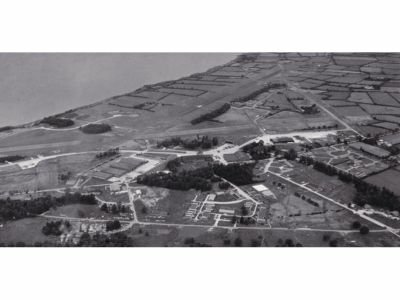
Photographed from an altitude of 2,500 feet, Langford Lodge in August 1943

The mastermind who led the project was LOC’s George Vernon Russell, whose design credentials and capabilities were undisputed. He attended the California Institute of Technology for a year before studying architecture at the University of Washington in Seattle. After graduating in 1928, he left for France, attending a summer course at the school of architecture in Fontainebleau, then travelling throughout Europe. Returning to the United States, Russell began his career as a draughtsman in New York City, then collaborated with Douglas Honnold, designing houses for some of Hollywood’s elite. In 1937, Russell co-designed the Hollywood Reporter Building on Sunset Boulevard. However, although his Californian home was renowned for its connection to the film industry, it was an altogether different type of business that would soon change the course of his life.
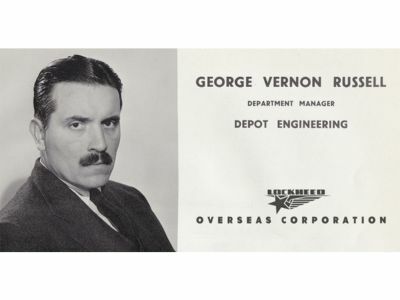
George Vernon Russell, 1942

The Lockheed Aircraft Company was founded in Hollywood in 1926 and moved to Burbank Airport in 1928. After America joined the war, Russell became involved with their LOC subsidiary and, by June 1942, had arrived in Northern Ireland, where, far from his Californian projects, Russell’s abilities were employed in the muddy fields of County Antrim. Appointed as the Department Manager Depot Engineering, and while construction at Langford Lodge was still in its infancy, Russell carried out a survey, recommending adjustments to the plans for production requirements. He oversaw a diverse range of work on the base, mainly focusing on its facilities, with his department developing specialist sections specifically for buildings, structural engineering, architecture, utilities, and electrical systems. By 1944, Russell’s department had completed projects at Langford that ranged from laying hardstandings to installing toilets and erecting hangars. Further afield, they carried out surveys at Greencastle and Maghaberry and oversaw the installation of synthetic training devices.
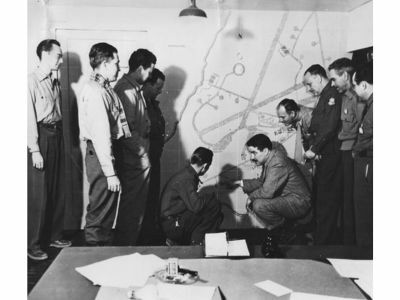
Russell pointing out the base hospital to colleagues on a wall plan of Langford Lodge.

Before the end of 1942, LOC’s technicians at Langford Lodge had proven they were clearly adept at delivering niche or unusual design projects. Over a year before SHAEF’s requirement arrived, they gained experience in fitting out semi-trailers by designing and building a workshop on wheels for the USAAF, known as a Mobile Repair Unit (MRU). That concept consisted of a tractor unit (commonly an Autocar U-7144T or Federal 94x43) towing two semi-trailers joined by a dolly. Externally, the trailers were comparable to the civilian Fruehauf Warehousemen’s Van, and the adapted design included one fitted as a workshop and another as accommodation. The units were intended to carry a team of specialists and equipment to the site of an aircraft’s emergency landing and effect the necessary repairs, enabling it to depart. Four MRUs had been completed at Langford by December 1942, and by July 1943, 21 were operating in the field. Initially manned by a combination of LOC and military personnel, LOC’s contribution was phased out as the military became more proficient. Under LOC supervision, a total of 512 aircraft were returned to service using the units.
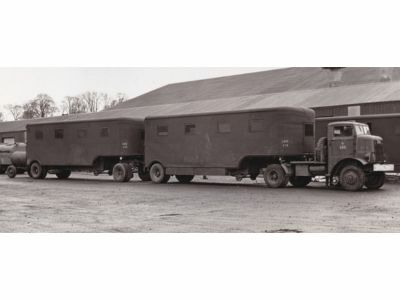
LOC Mobile Repair Unit (MRU) at Langford Lodge prior to delivery.

At a glance, Eisenhower's trailers looked somewhat similar to the MRU. However, the main body was based on an existing Keystone 8-Ton Instrument Shop semi-trailer used by the USAAF for the repair, calibration and maintenance of aircraft instruments. Measuring 28 feet in length, one trailer was fitted out as an operations room, with a conference table, maps wound on recessed rollers and a projection screen. With the exterior retaining a stock military look, Russell was responsible for the design of the interior, which, although utilitarian in design, was clearly above normal army specifications: described as a study in glistening chrome, highly polished black linoleum floors, delicately tinted pearl grey walls and ceilings and green leather upholstered furniture. Additionally, a smaller caravan was converted from a mobile photo laboratory into living quarters. All the trailers were built using existing stock and parts held at Langford Lodge, and the initial units were completed in 60 days. As the first trailers were ready for deployment, Russell’s involvement came to the attention of the media and was widely reported in American newspapers. Some of them describe his creation as the ‘Shaef-mobile.’
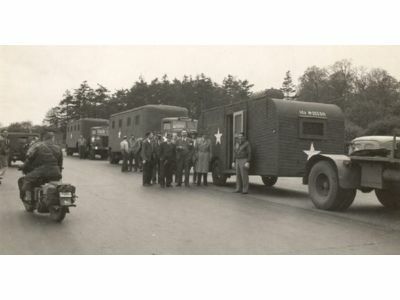
Eisenhower's trailers waiting to depart Langford Lodge, with Russell centre in the group.

As preparations for D-Day accelerated, SHAEF split its headquarters operations between two sites: SHAEF Main at Bushy Park and SHAEF Forward near Southwick House, just north of Portsmouth. Code-named SHARPENER, it was here that the trailers were first employed, hidden under trees and camouflaged netting. Unusually, the lengthiest account describing them appears in Cornelius Ryan’s 1959 book The Longest Day. In it, Eisenhower was described trying to relax in his sparsely furnished trailer, which Ryan noted the General had now christened his ‘Circus Wagon.’

‘Eisenhower's trailer, a long, low caravan somewhat resembling a moving van, had three small compartments serving as bedroom, living room and study. Besides these, neatly fitted into the trailer's length was a tiny galley, a miniature switchboard, a chemical toilet and, at one end, a glass-enclosed observation deck. But the Supreme Commander was rarely around long enough to make full use of the trailer. He hardly ever used the living room or the study; when staff conferences were called he generally held them in a tent next to the trailer. Only his bedroom had a "lived-in" look. It was definitely his: There was a large pile of Western paperbacks on the table near his bunk, and here, too, were the only pictures -- photographs of his wife, Mamie, and his twenty-one-year-old son, John, in the uniform of a West Point cadet. From this trailer Eisenhower commanded almost three million Allied troops.’

The trailers remained at the SHARPENER camp for two months. However, SHAEF would soon be on the move with one contemporary account saying, ‘When General Eisenhower moved his headquarters from Britain to France to maintain the closest possible contact with his rapidly advancing armies, he took with him a three-unit trailer caravan which was designed and built at the Lockheed Overseas Corporation base in Northern Ireland.’
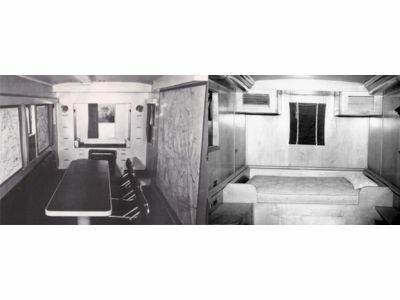
Interior of the command trailer looking towards the rear and the bed in an accommodation trailer.

The trailers were deployed in a camp code-named SHELLBURST and situated near Tournières, France. Established on 7 August, this new SHAEF Forward was where Eisenhower welcomed Prime Minister Winston Churchill, General Charles De Gaulle and a string of senior military figures. The trailers remained there until September, after which SHAEF Forward moved to Reims, then to Versailles. By the middle of February 1945, SHAEF Forward had moved indoors at the Collège Moderne et Technique de Reim, where the first act of surrender of Nazi Germany was signed on 7 May 1945.

One example did survive the post-war period. After returning to the United States in 1955, it was acquired by the US Army Quartermaster Museum, where it was stored. It was fully restored and, in 2001, placed on permanent public display inside the museum.
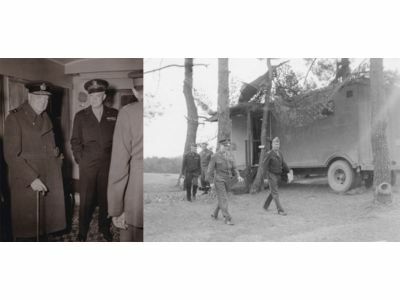
Churchill visiting Eisenhower in his trailer at Reims, 15 November 1944 (left). Eisenhower with Lt Gen Jacob Devers leaving a trailer, September 1944 (right).

As for Russell, after the LOC contract ended and a year after the trailers were deployed to France, Russell returned to California and the world of architecture. Factories and a hospital were among his first projects. Russell joined the American Institute of Architects (AIA), Southern California Chapter, in 1947, and became its director from 1955 to 1958. He later designed buildings for the Lockheed Aircraft Service Inc. at Ontario International Airport.
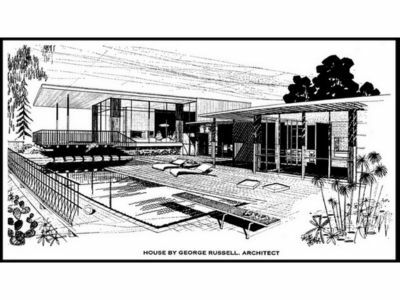
George Vernon Russell - Millikan Residence - Southern California (1960).

George Vernon Russell died aged 83 at his Pasadena home on 17 March 1989. While the numerous buildings he designed are a testament to his design capabilities, when Russell left Northern Ireland and returned to the US, he took with him the plans for Eisenhower's trailers. If anything, it's indicative of the pride he had in that particular project and its small contribution to the war effort.

About the author:

Clive Moore is the author of NIWM publication, The American Red Cross in Northern Ireland during the Second World War, and runs the US Forces in Northern Ireland during WW2 Flickr page.

With thanks to:

  • Colin Russell
  • The US Army Quartermaster Museum
  • Sources: National Archives and Records Administration and Air Force Historical Research Agency
You May Also Like

Card image cap
Biography: Brigadier General Leroy P Collins
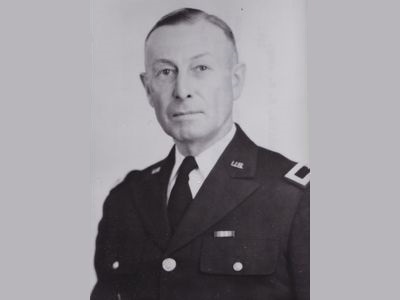
Guest author Clive Moore looks at the role and impact of Brigadier General Leroy P Collins (pictured in his Officers Blue Dress uniform in 1941) during the fourteen months he spent in Northern Ireland over two separate postings: a longer period than any other commanding officer, or possibly any other person in the United States military that served in Northern Ireland.
Card image cap
Wartime Bomb Disposal
Author Chris Ranstead writes on the dangers posed by unexploded bombs known as UXBs and the men of 27 Bomb Disposal Company that made them safe long after the Belfast Blitz in 1941.
Card image cap
Polish Squadrons in Northern Ireland Part 1: No. 315 (City of Deblin) Polish Fighter Squadron
Its common knowledge that No. 315 and No. 303 (Polish) Squadrons were based at RAF Ballyhalbert, County Down during the Second World War but what was their role here?
Card image cap
Polish Squadrons in Northern Ireland Part 2: No. 303 (Kosciuszko) Polish Fighter Squadron
Its common knowledge that No. 315 and No. 303 (Polish) Squadrons were based at RAF Ballyhalbert, County Down during the Second World War but what was their role here?
Card image cap
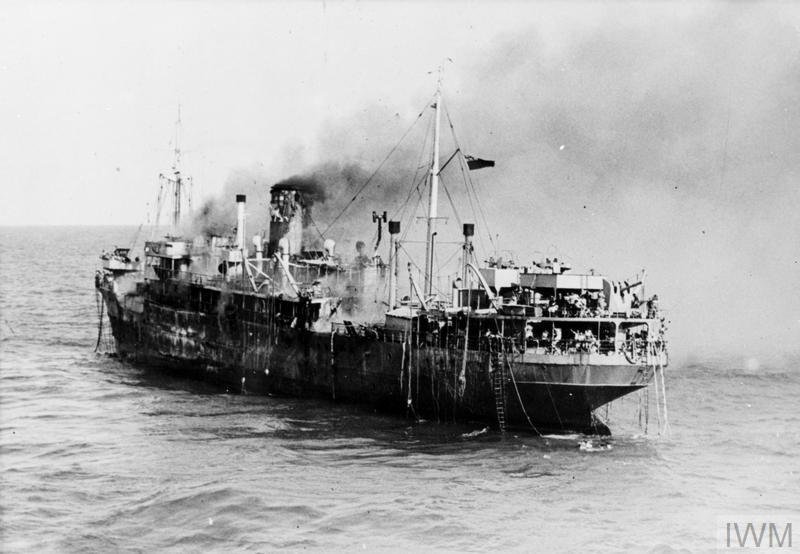
The Epic of the Empire Patrol
On 29 September 1945, the SS Empire Patrol caught fire shortly after leaving Port Said. On board were hundreds of Greek refugees who were returning home to Castellorizo. Within the NIWM collection is an eyewtness account from Ordinary Seaman Stanley Scott of their rescue by the escort carrier, HMS Trouncer.
Card image cap
The US 'Technicians who won't talk'
American forces officially arrived in Northern Ireland on 26 January 1942 with PFC Milburn Henke being selected to be the 'first' to walk down the gangplank. However, hundreds of American technicians had already spent much of 1941 in Northern Ireland, well before the US entry into the war, building US Naval Operating Base Londonderry and a seaplane base at Lough Erne. Discover more about their time in Northern Ireland here:
Card image cap
Queer Life during the Second World War
To mark LGBT+ History Month, NIWM Outreach Officer, Michael Fryer, explores queer life during the Second World War. Please note that this article contains sexual references and may be inappropriate for younger readers.
Card image cap
‘As welcome as the Germans in Norway’: Irish Nationalism and the American presence in Northern Ireland
Dr Simon Topping, author of 'Northern Ireland, the United States and the Second World War' provides an overview of how the leaders of Irish Nationalism regarded the arrival of thousands of American soldiers in Northern Ireland in 1942.
Card image cap
Clothing Rationing
The Board of Trade introduced the immediate rationing of clothing and footwear on 1st June 1941. Read on to find out more.
Card image cap
Sweet Rationing
#DidYouKnow? That on 26th July in 1942 sweets were rationed! The initial allowance was 8 oz per person for a 4 week period… that’s only 2 oz per week! Read on to find out more.
Card image cap
The Last Man’s Club of Battery B
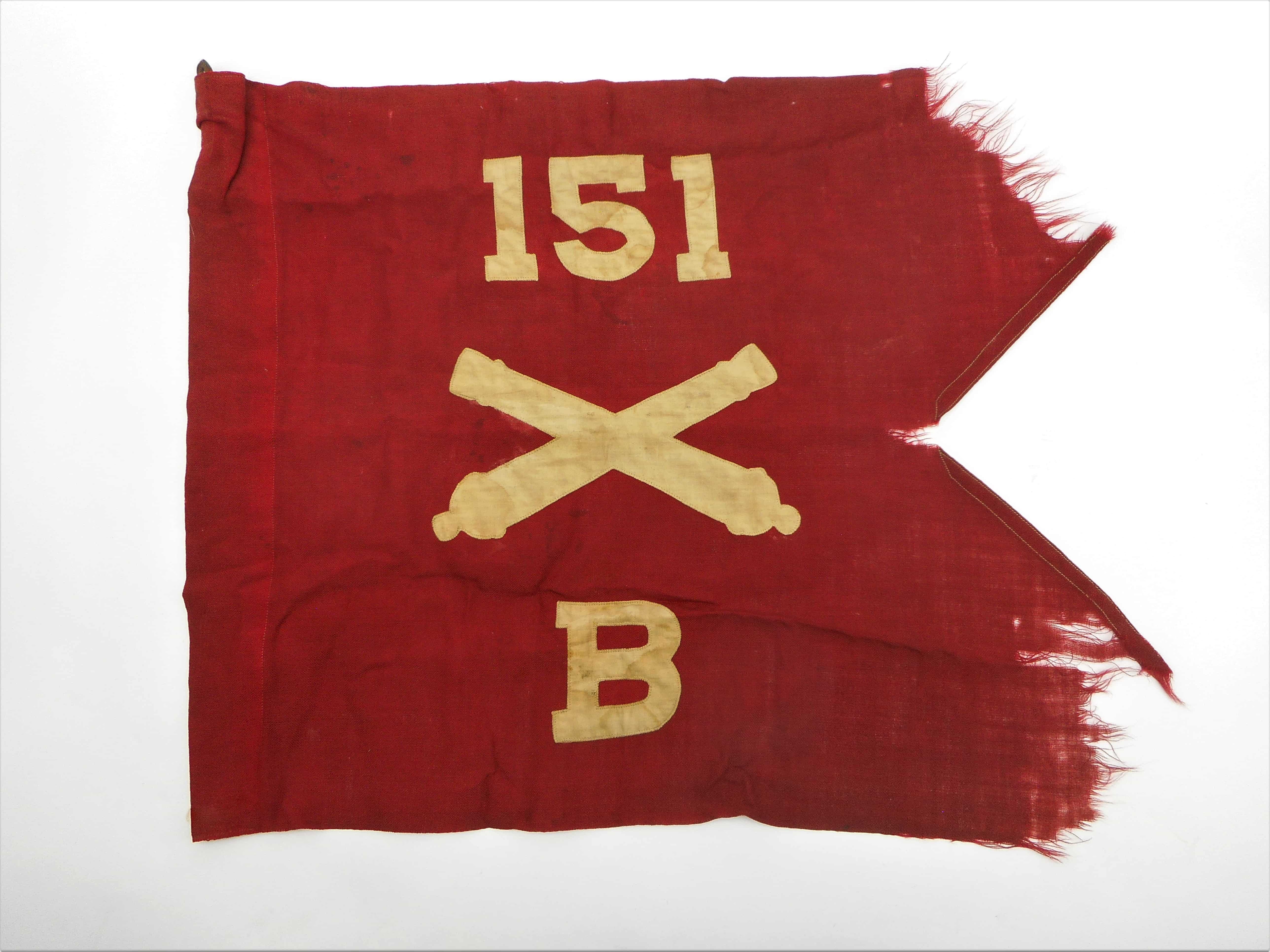
As well as being the first US division to land in Europe during the Second World War, the 34th 'Red Bull' Infantry Division also fired the first American artillery at German forces. This shell was fired by B Battery, 175th Field Artillery Battalion at Medjez-El-Bab, Tunisia, on 19 November, 1942. Although B Battery of the 175th was first to fire in combat, the very first American artillery fire in the European Theatre was delivered by B Battery of the 151st Field Artillery Battalion whilst based in Northern Ireland during 1942. This is the story of how a group of men became bonded for the rest of their lives by a spent shell casing and a bottle of good Irish whiskey.
Card image cap
Coastal Crusts and Stop Lines
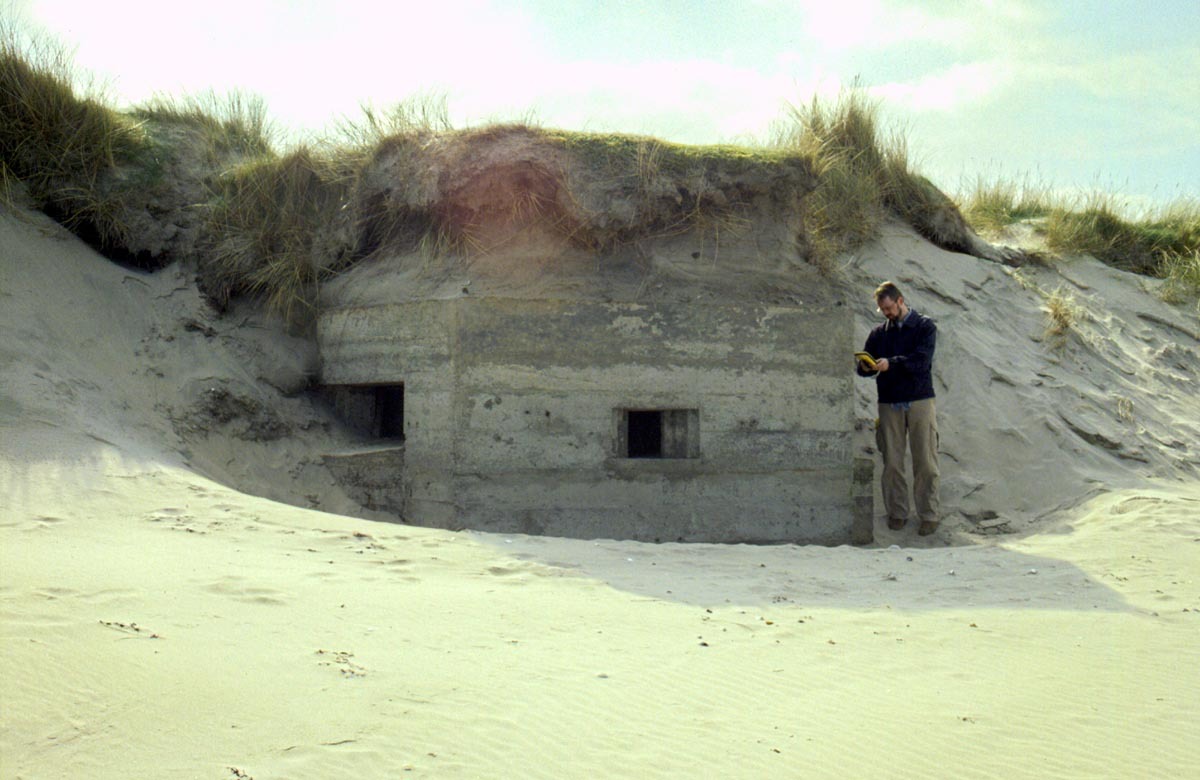
In Coastal Crusts and Stop Lines, Dr James O'Neill highlights the anti-invasion defences of Northern Ireland during the Second World War. Pictured is a coastal pillbox emerging from the sands at Magilligan Strand (Co. Londonderry). The dune system swallowed it up again soon after this photo was taken.
Card image cap
Royal Air Force Marine Craft
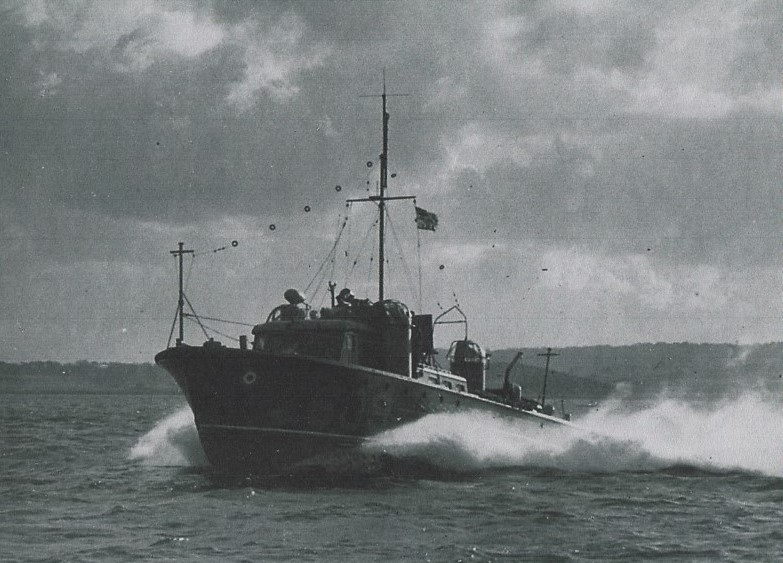
Much has been written about Northern Ireland’s role in helping to bring about the Allied victory in the Second World War. One aspect however has been overlooked and does not get the attention it deserves - the Royal Air Force Marine Service. In this article, Guy Warner shines a light on its role as a vital enabler not only with regard to the Battle of the Atlantic but also Air Sea Rescue.
Card image cap
Aviation Archaeology in Ulster - A Personal Overview
Tens of thousands of aircrew flew training and operational sorties from air bases in Northern Ireland during the Second World War. Sadly, many aircraft and their crews were lost to accidents and mechanical failures. Typically the airframes were recovered, but where that was not possible the wreckage remained buried. Aviation expert Jonny McNee introduces us to his efforts to recover four of these lost aircraft.
Card image cap
Still Over Here Part 1: The archaeology of the United States military in Northern Ireland, 1941-45
'Over There' was a patriotic song about GIs coming to Europe to aid the allied cause. 'Still Over Here' looks at the physical remains of the structures left behind by the hundreds of thousands of US personnel who passed through Northern Ireland during the Second World War. In Part 1 we look at the traces of the US Navy, Army and the structures that remain hidden in the landscape.
Card image cap
Still Over Here Part 2: The archaeology of the United States military in Northern Ireland, 1941-45 - The United States Army Airforce
In Part 2 of 'Still Over Here', Dr James O'Neill examines the remains of the largest remaining sites relating to the US presence in Northern Ireland during the Second World War: the USAAF airfields. As the conflict escalated and losses mounted, six airfields were handed over to the USAAF, training crews and modifying aircraft for the battles in the air over Europe. With each airfield covering hundreds of acres, they are often hidden in plain sight, but many features remain to tell their story.
Card image cap
The War for Industrial Production
In 'The War for Industrial Production', Dr Christopher Loughlin takes a look at industrial relations in Northern Ireland during the Second World War. Often overlooked in official accounts of the conflict, Dr Loughlin explores how organised labour surged during the war years, and how relations between employers were often fractious, leading to industrial disputes and strikes.
Card image cap
Diamonds in the Emerald Isle; The 5th Infantry Division in Northern Ireland
Often overlooked for more famous military formations like the 82nd Airborne and 1st Armored Division, the 5th Infantry Division was one of four American infantry divisions stationed in Northern Ireland during the Second World War. Reactivated in October 1939, the division spent nine months intensively training in the north before setting sail for battlefields in Europe.
Card image cap
Love In War
Introducing our new blog series #LoveInWar; a collection of blog posts highlighting love stories from our Oral History Collection.
Card image cap
Field Hospital Training for U.S Medical Battalions in Northern Ireland
Approximately 300,000 US service personnel passed through Northern Ireland during the Second World War. Our guest blogger, Dave Hickman from Johnston, Iowa, tells us the story of his father’s time in Northern Ireland as part of the 109th Medical Battalion (34th Infantry Division) that landed in Belfast in March 1942.
Card image cap
"The Bravest Man never to have been awarded a VC": A re-examination
In "The Bravest Man never to have been awarded a VC": A re-examination, guest blogger and NIWM Visitor Assistant, Mark Johnston, explores the myths that surround one of Northern Ireland's most enigmatic soldiers, Lt Col Blair "Paddy" Mayne.
Card image cap
Nobody Died in the Blitz
Guest blogger, Matthew Maw, examines how three Belfast artists represented the Blitz in their work, with a blog post entitled, ‘Nobody Died in the Blitz’. Matthew puts the artists portrayals in the wider context of the ‘War Art’ genre and asks questions about the taboos and self-censorship that are involved when painting such devastating acts of violence against the human body.
Card image cap
The Stormont War Room
In this blog, NIWM Research Officer, Michael Burns offers a glimpse into the operations of local Civil Defence efforts on the four fateful nights Belfast was subjected to enemy attack. This blog focuses on the story of Stewart O’Fee (1915-2004), a civil servant during the Second World War and volunteer Intelligence Clerk in the Civil Defence War Room based at Stormont Castle.
Card image cap
James Magennis VC
NIWM Collections Officer, James O'Neill, charts the story of Leading Seaman James Magennis was the only person from Northern Ireland to be awarded the Victoria Cross during the Second World War. Raised just off the Grosvenor Road, Belfast, poverty led him to join the Royal Navy, where his actions during Operation Struggle and the attack on the IJN Takao earned Magennis Britain’s highest honour.
Card image cap
Victory Over Japan: Memories from the NI War Memorial
NIWM's Research Officer, Michael Burns, explores how Victory over Japan was celebrated in Northern Ireland in August 1945 as recorded in our oral history collection.
Card image cap
Danger UXB: The hidden legacy of the Belfast Blitz
When a bomb was discovered at Rivenwood housing development in Newtownards in August 2024, it sparked an interesting question - was this the first bomb to be found since the end of the Second World War? Our Collections Officer, Jim O'Neill, wasn't entirely sure, so we decided to do a bit of digging. A search through the newspaper archives soon revealed that several similar discoveries had been made over the years.

Subscribe To Our Mailing List For Updates