Blog
Air Raid Precautions in Northern Ireland
The horrors of the First World War ushered in a new and unprecedented threat to civilian populations: attack from the air. Starting in 1915, slow-moving Zeppelins and biplane bombers such as the Gotha attacked London and targets outside the capital. The attacks had limited effect, killing approximately 1,500 over c.100 raid, but post-war technology improved, and bomb loads became heavier.
The threat of airpower to civilian populations was brought home during the Spanish Civil War with the aerial attack on Guernica. On 26 April 1937, waves of German and Italian bombers (serving with the Spanish Fascists under General Francisco Franco) devastated the town. The number killed is still disputed, varying from 150-1554, but the impact profoundly shocked Western observers. Moreover, the continuing development of chemical weapons meant action had to be taken to provide protection to the civilian population.
Air Raid Precautions Established
At the start of 1938, the Air Raid Precautions (ARP) Act came into force, compelling local authorities to establish ARP schemes.
These were to be made up of;
- wardens
- first aid parties
- emergency ambulances
- gas decontamination units
- rescue parties
- repair and demolition detachments
This was expanded to include local fire services and first aid posts, gas cleansing depots, casualty clearing hospitals, and later the Auxiliary Fire Service (AFS). The Act provided 60-75% funding from central government, but crucially, this did not apply to Northern Ireland.
When the NI government passed its own civil defence legislation for councils to form ARP in their districts, it did not make it compulsory. This, compounded by general apathy, led local government to see it as a waste of money and the responsibility of central government.
Recruitment was slow in Northern Ireland. Moreover, some employers even forbade employees from joining the ARP. Consequently, limited numbers hindered the ARP and initially restricted its ability to distribute gas masks.
ARP was split into several operations sections with distinct roles and functions;
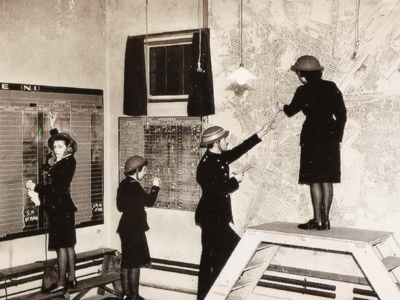
Report and Control Centres
Report centres received reports from wardens of incidents around the city during a raid. Their job was to collate and sift the reports, turning raw data into an accurate picture. Reporting staff had to ensure incoming reports did not swamp the control centre, enabling them to respond appropriately.
Control Centres coordinated the ARP response, with staff using maps to view the situation. They would decide on a course of action, dispatching parties from posts and depots in response to incidents. They also had powers to activate rest centres, feeding centres, and mortuary services, and to call in reinforcements if overwhelmed.
Casualty Services
This was vital to morale, as people needed confidence that if they were injured, someone would be there to help. This help could come in many forms;
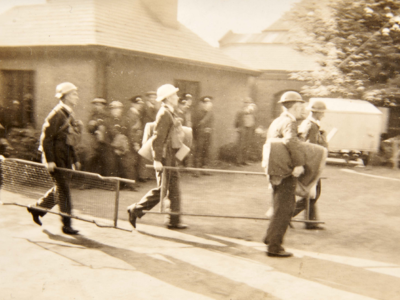
First Aid Parties: Teams of 3-4 first aiders were directed to incidents. On arrival, they treated minor injuries and sent people home. The more serious cases were sent to first aid posts or directly to casualty clearing hospitals.
First Aid Posts (FAP): For casualties needing a doctor, they acted as a triage point to protect casualty clearing hospitals from a sudden onrush of minor wounds. They could also treat and stabilise bleeding casualties before transport to a Casualty Clearing Hospital. FAPs had 16-40 staff, including a doctor, nurse and first aiders.
Casualty Clearing Hospitals (CCH): This was where the most serious cases went for treatment. Casualty clearing hospitals were fully equipped to receive large influxes of casualties, as well as treating shock and conducting stabilisation surgery, often while the air raid was ongoing. Casualty Clearing Hospitals usually operated with sixteen to forty staff, including doctors, nurses and first aiders.
Ambulance Service: These operated from depots to bring casualties to FAP and CCH.
Gas Identification and Decontamination
Gas Identification Officers: Called by wardens to confirm the presence and identify chemical agents should they be deployed.
Gas Decontamination Parties: Made up of 6 men (women were not allowed) equipped with heavy protective suits. Their job was to decontaminate roads and buildings by washing them with bleach.
Gas Decontamination Centre/ Cleansing Stations: Established to provide decontamination facilities. They used bleach baths and showerers to decontaminate individuals and equipment, and had stores of clean clothing and access to laundry facilities.
Rescue Parties
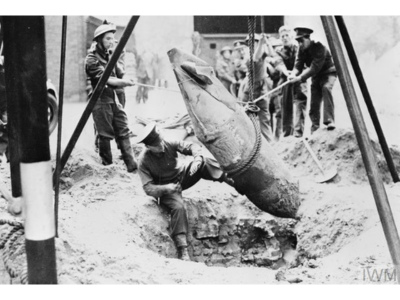
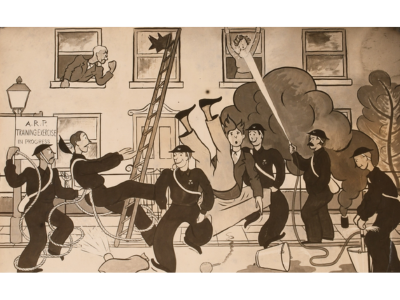
Parties trained to rescue people trapped in damaged or destroyed structures, initially split into rescue, repair and demolition parties. Light rescue parties had hand tools, whereas the heavy units used specialist equipment such as jacks, blocks and tackle, oxyacetylene cutters and sometimes cranes.
Fire Watch
To combat firebombing, the Fire Watchers Order was issued in September 1940, requiring employers to patrol premises at night, but it was poorly organised and was replaced by the Fire Watchers Scheme in January 1941. This new decree meant that buildings within certain designated areas had to have a fire watcher present 24 hours a day. They were to deal with incendiaries as best they could and call on the fire and rescue parties as required. However, the scheme proved difficult to implement in Belfast, as employees sought overtime payments, while others believed they should be with their families in times of danger, not protecting their employer's property.
Wardens
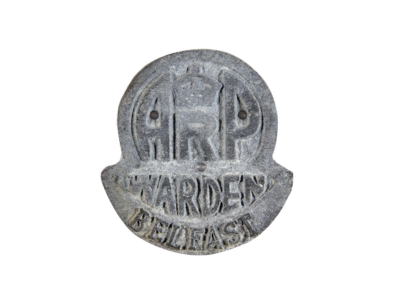
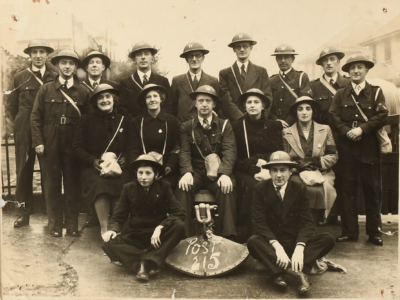
A warden's chief duty was to contact citizens, advise on precautions, and man a post to report damage and being coordinating relief measures. Staffed by both men and women, they were assigned to their local street or streets and were expected to know their district thoroughly, including who lived where and who had mobility issues. They also needed to know where the gas lines and stopcocks were.
Wardens handled immediate coordination, but only after reporting to the reporting centre; that was their primary job. They helped civilians to shelters, assisted with rescue, gas measures, and mitigation, and set a good example to others. Wardens were generalists rather than specialists. They provided all relevant information to arriving rescue units and helped control untrained civilians before units arrived.
Given the likelihood of communication disruptions, wardens were supported by messengers. These were often children (12-18 years old) who carried messages, often by bicycle.
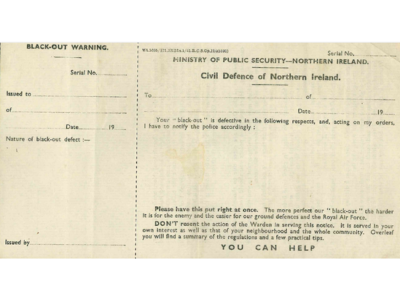
Wardens also had an educational role, teaching civilians how to put on respirators, take appropriate action when they heard an air raid warning, and get to shelters during a raid. They also enforced the blackout, which often made them unpopular with the communities they served.
The Blackout
Northern Ireland instituted a blackout on 1 September 1939. It was imposed to prevent enemy bombers from finding their targets at night. Homeowners were required to put blackout curtains or card over windows and doors to prevent light from escaping. Where these could not be used, windows were painted black. Streetlights were switched off, and covers were put on traffic lights to direct their beams downwards. Vehicle headlights were covered, with a single light protected by a slotted cover that again directed the light downwards. Overhead factory windows were painted over, causing morale and energy-use problems, as factories had to keep lights on during the day.
To make it easier to navigate in the gloom, kerbs, pillars, streetlights/furniture, trees, railings, and steps were painted in white stripes to make them more visible during the blackout. Despite these precautions, the accident rate soared during the hours of darkness.
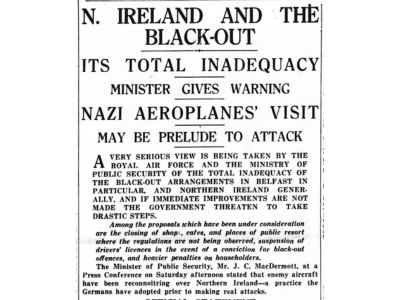
ARP and Public Opinion
Many in Northern Ireland saw ARP activities and demands as intrusive in their everyday lives and railed against them, often ignoring the provisions. Public attitude ranged from indifference to outright hostility.
This covered all classes. Lady Londonderry called the ARP effort ‘All sorts of rot’ and disparagingly noted that no one would really care to bomb Belfast. Moya Woodside, from a middle-class unionist background, chafed at the restrictions and dismissed the blackout as a political stunt. Blackout preparations took her 10 minutes a night, which she considered too much: ‘how we grudge the time spent! I prefer to run the risk of a bomb falling nearby rather than live for the duration in the room that reminds me of a dungeon’.
Her greatest loathing (shared by many) was for the ARP warden, whom she described as an 'officious fusspot'. She described how he 'rushed aimlessly up and down the street, clad in his mac, tin helmet, gas mask and other paraphernalia'.
People generally, but grudgingly, complied with restrictions; however, fines for breaches were common, with approximately 15,000 prosecutions in Northern Ireland for violating blackout restrictions.
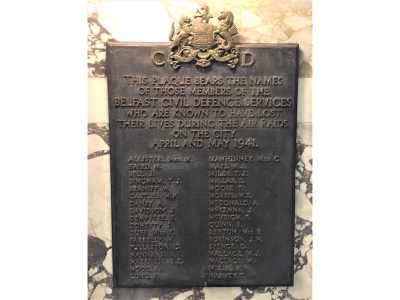
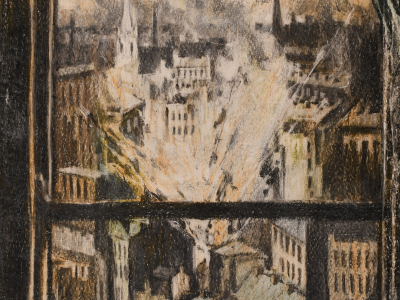
The ARP faced its ultimate test during the four air raids in April and May 1941, when, in two major and two smaller raids, over 400 tons of high explosives and over 120,000 incendiaries rained down on Belfast and surrounding districts, killing almost 1,000 people and destroying/damaging almost half the housing in the city. ARP staff and volunteers were heavily engaged during the raids, saving countless lives but at the cost of 34 of their own, killed during the attacks or as a result of their injuries.
After the devastating attacks, the ARP expanded substantially, with enlistments in the Belfast service peaking at 8,500 in June, up 50 per cent from the previous March. The ARP, renamed Civil Defence in 1941, continued its duties throughout the war but was finally stood down in May 1945, when the war in Europe ended.