BLOG
First Aid in the Blitz: Civilian Care in Wartime Belfast
On the night of 15 April 1941, Belfast came under one of the most devastating air raids in the United Kingdom during the Second World War. German bombers blasted the north and west of the city. Within hours, houses and air raid shelters had collapsed, fires had taken hold, and thousands of people had been killed, injured, or left homeless. Amid the confusion and terror, first aiders worked to help the injured. Their job was straightforward in principle: reach casualties, give immediate care, and get people to safety. The reality, however, was much more frightening.
The destruction caused by the Belfast Blitz is well remembered. Less often discussed is the emergency medical response that followed. Without the work of first aiders and civilian medical services, the human cost of the four raids would have been even greater.
Preparing for Air Raid Casualties
By the late 1930s, the British government expected that any future war would see attacks on towns and cities from the air. The First World War had already demonstrated that civilians could become targets. Now, the fear was that aerial bombing could cause mass casualties and destroy homes, workplaces, and streets.
Air Raid Precautions (ARP) became a major part of wartime planning. It brought together many aspects of Civil Defence, including wardens, rescue services, fire guards, ambulance drivers, and first aid parties. This was the Home Front as a practical system, not simply a slogan.
The first officially recognised casualty of the Belfast Blitz occurred in the Dockside Raid, 7-8 April 1941. He was a warden who was injured by shrapnel while making his way to his post before the air raid sirens had sounded. He was taken to Mersey Street First Aid Post.
First Aid Posts were set up across town and cities to give quick treatment to injured civilians before they could be moved to a hospital. By April 1941, Belfast had around 30 First Aid Posts. Some were based in fixed locations, while around half were housed in converted single-decker buses to bring first aid closer to damaged areas. These posts were never intended to replace hospital care. Their purpose was to handle casualties efficiently, especially those suffering from cuts, burns, fractures, shock, blast injuries, and heavy bleeding.
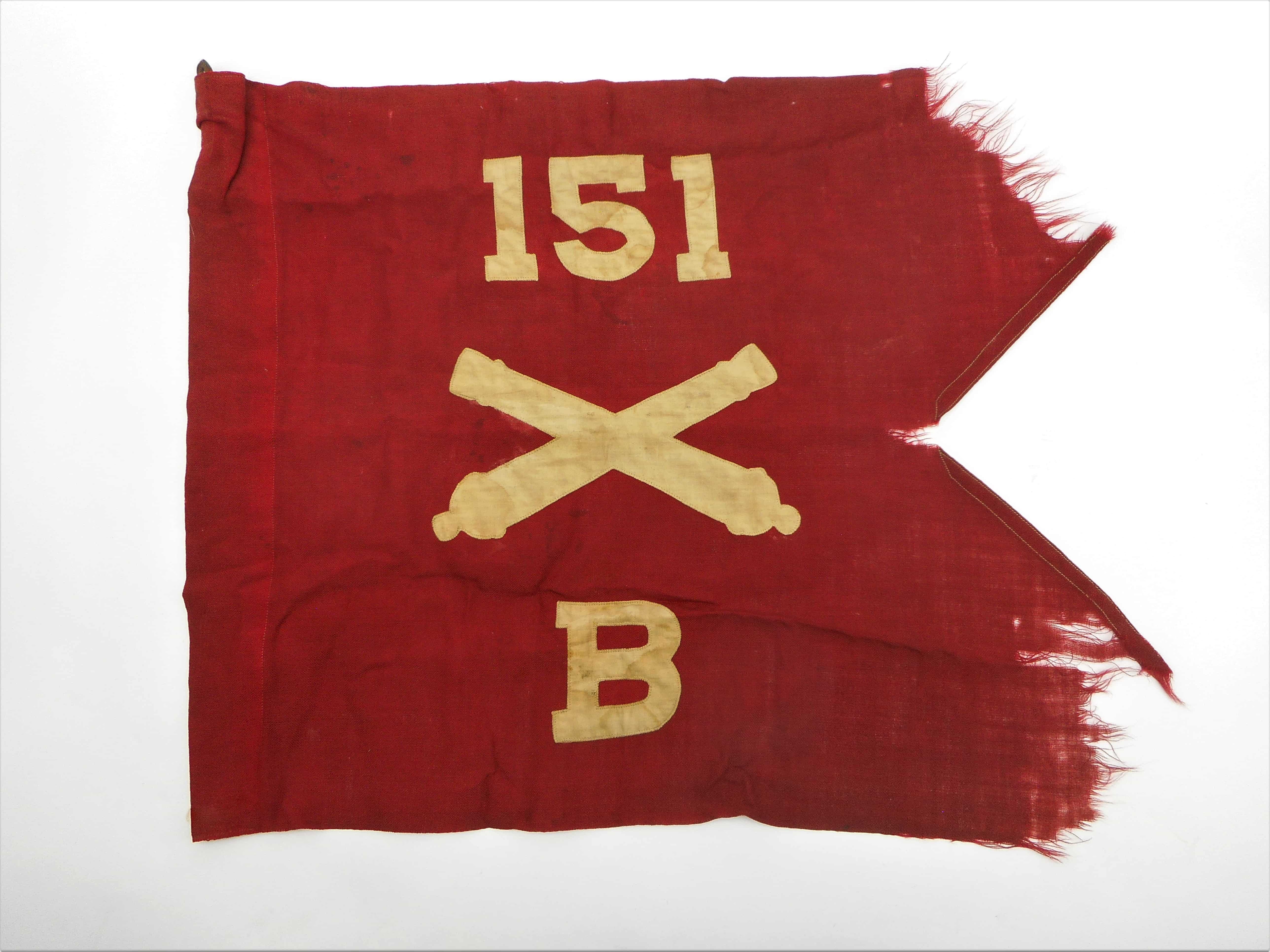
Members of First Aid Parties were identifiable by helmets marked ‘FAP' (First Aid Party). These teams were trained to provide urgent treatment, organise casualties, and support the wider medical response before the injured could be moved to First Aid Posts or hospitals. This training mattered because during the Belfast Blitz, first aid was no longer an abstract skill practised and prepared for in a classroom. It was being delivered under harrowing conditions in streets filled with debris, in overwhelmed casualty posts, and in hospitals that were pushed far beyond their limits.
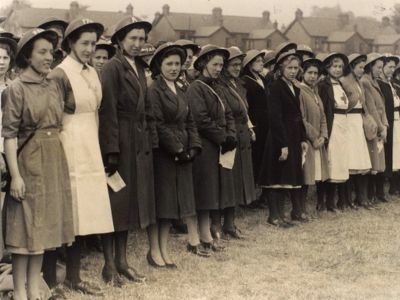
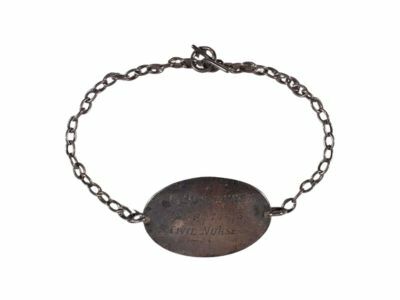
The Civil Nursing Reserve was an important part of Belfast’s emergency medical response. Nurses worked alongside first aiders, ambulance crews, wardens, and other Civil Defence personnel to care for casualties during and after the Belfast Blitz.
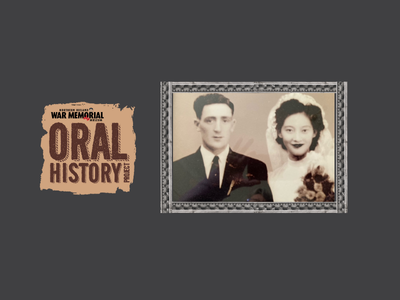
Voluntary organisations were central to this work. St John Ambulance and the British Red Cross brought important first aid experience into the Civil Defence system. Men and women learned bandaging, stretcher drill, emergency treatment, and how to respond to the kinds of injuries expected during an air raid. Kathleen Bainbridge (née Burgoyne) served as a British Red Cross nurse in Belfast during the Second World War. During the war she married Lt. J. R. Bainbridge, an official War Office photographer, resulting in many photos of Kathleen.
First Aid in Action
First aiders had to make quick decisions, particularly during air raids. Their medical care often centred on dressing wounds, controlling bleedings, immobilising broken bones, treating burns, and supporting people experiencing shock. Stretchers were used to carry casualties to First Aid Posts, ambulances, and hospitals.
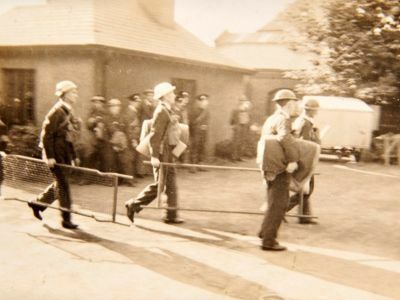
First aid equipment was often basic, but it could make the difference between a person living or dying. First aid kits included dressings, triangular bandages, antiseptics, splints, and other emergency medical supplies.
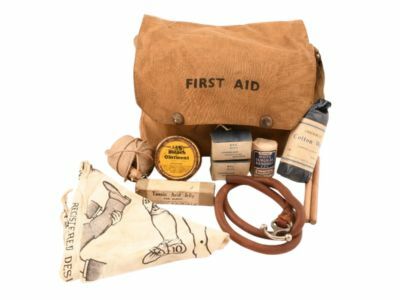
Wartime medicine did not only happen in hospital wards or operating theatres. It also happened in streets, air raid shelters, converted buses, and improvised treatment spaces. Care was given wherever it was needed.
First Aid during the Belfast Blitz
The greatest test of Belfast’s first aid preparedness came during the Easter Tuesday Raid of 15-16 April 1941. North and west Belfast were hit especially hard, including areas around the Falls, Shankill, New Lodge, and the Crumlin Road. The Mater Hospital, close to some of the worst-affected streets, received huge numbers of dead and injured people. The casualty post at the hospital was forced to carry out emergency surgery, including amputations, as the hospital was quickly overwhelmed.
A nurse's report from a casualty post near Academy Street in Belfast described 65 patients arriving for treatment. Casualty 'number seven' was carried into the post early in the raid by two policemen:
Both his legs were fractured and were almost severed and he was bleeding profusely. The Medical Officer decided that an amputation was necessary and this was performed. The patient was a warden and did not realise the extent of his injuries and kept urging us to hurry and put a bandage on as he had work to do and his helmet was blown off and he was anxious to find it. (Brian Barton, The Belfast Blitz: The City in the War Years, Ulster Historical Foundation: Belfast, 2015, p.213).
First Aid Posts treated up to 150 cases in a single night, exceeding their normal capacity. In one case, around 40 patients were being treated simultaneously in a single post. First Aid Parties also struggled to keep up with the extent of the disaster.
Professor T.T Flynn, head of Belfast's casualty service and Errol Flynn's father, stated that 'the greater number of casualties were due to shock, blast and secondary missiles such as glass, stones, pieces of piping, etc. There were many terrible mutilations among the living and the dead - heads crushed, ghastly abdominal and face wounds, penetration by beams, mangled and crushed limbs, etc.' (Brian Barton, The Belfast Blitz: The City in the War Years, Ulster Historical Foundation: Belfast, 2015, p.214).
These accounts show what the language of casualties and emergency response can hide. First Aid during the Blitz meant treating catastrophic injuries in overcrowded First Aid Posts while the raid was still unfolding.
Belfast’s hospitals had made preparations for war, but nothing could make the air raid casualties easy to manage. Hospitals had previously been instructed to restrict admissions and identify patients who could be discharged quickly. In practice, however, there was limited extra capacity when the Easter Tuesday Raid happened.
The Royal Victoria Hospital came under enormous pressure. Before the Blitz, windows were strengthened and operating theatres were reinforced. Despite this, the hospital’s resources were stretched once the raids began. The dead were identified where possible and sent to the mortuary. The injured were treated immediately or admitted to wards. Operations continued under emergency lighting while bombs fell over Belfast. Nurses later remembered working by torchlight, treating people who arrived without name tags, and caring for patients who were burned, bleeding, or close to death. Some casualties were so shocked that they could not remember their own names.
The City Hospital and Jubilee Maternity Wing also received casualties. Although they were further from some of the worst-hit areas, staff still remembered ambulance after ambulance arriving. The morgues quickly filled.
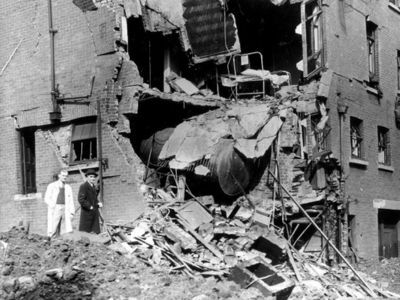
During the Easter Tuesday raid, the Ulster Hospital on Templemore Avenue was badly affected. The damage to hospitals also stayed in the memories of people who saw Belfast in the aftermath. Margaret 'Peggy' Burns, née Blaney, was 14 and from Kenilworth Street. She remembered sheltering under the kitchen table during the Easter Tuesday Raid and passing the Women and Children’s Hospital on Templemore Avenue the next morning:
I remembered my mother taking us home to Belfast for Easter, and on that Easter Tuesday night we lived through one of the heaviest air raids; it was very frightening as we sheltered under the kitchen table of our home. On the Wednesday morning as we were going back to the country, we passed the women & children's hospital in Templemore Avenue, Belfast, which has suffered a direct hit the night before. I will never forget seeing the beds hanging precariously out of the damaged wards. A number of people were killed there that night. A long time after, I realised God had been good to us and kept us safe, but no family remained untouched by the war. (Extract from NIWM Oral History Collection).
The Fire Raid, 4-5 May 1941
Belfast was attacked again on the night of 4-5 May 1941, in a raid that became known as the Fire Raid. The Ulster Hospital on Templemore Avenue was again badly affected. Surgeon M. I. McClure, of the Ulster Hospital, later recalled bombs falling nearby, gas and electricity being turned off, and staff waiting in the dim light of hurricane lamps as the building shook with each explosion.
Incendiary bombs fell around the hospital and onto its roof. When the building was hit, staff tried to use internal hoses to put out the fires, but the water mains had been damaged. Fortunately, patients had already been evacuated after the Easter Tuesday Raid, but the hospital itself suffered serious damage.
Nearby, Templemore Avenue Public Baths were also damaged. By the time of the all-clear, the First Aid Post beside them had treated more than 40 casualties.
Lessons Learned
After the Belfast Blitz raids, Civil Defence authorities reviewed what had happened. They found that ambulances and First Aid Parties had not always been used efficiently. At one point, too many resources were concentrated in Belfast city centre, while some parties brought in from other areas had little to do.
Officials also criticised the location of First Aid Posts in the external departments of Belfast’s main hospitals. These posts were meant to prevent the hospitals from becoming overcrowded. During the raids, however, they became filled with the wounded, the dying, and the dead.
Fears of further raids spurred ideas for change, with plans for more vehicles, including the conversion of cars into ambulances and transport for First Aid Parties. First Aid Posts were to be provided with increased supplies, and military first aid posts were also prepared for use by civilian casualties.
Remembering the People Who Cared
The Belfast Blitz was not only a story of bombs and buildings. It was also a story of people who had trained for a crisis they hoped would never come. First aiders, nurses, ambulance drivers, wardens and volunteers who worked in dangerous conditions, often while bombs were still falling. They cared for people in moments of pain, shock and loss. Their work reminds us that the Home Front depended not only on endurance, but also on organisation, training, and people willing to step forward when needed. Remembering their work gives us a fuller, more honest picture of the Belfast Blitz and of how the city responded when it was at its most vulnerable.
About the Author:
Dr Rebecca Watterson is a historian of medicine, mental health and public history. Her work explores the histories of psychiatric treatment, lived experiences of mental ill-health, stigma, social exclusion, and the hidden histories of health and care from the nineteenth century to the modern day. She is also the Education Officer at the Northern Ireland War Memorial Museum, where she develops and delivers creative learning programmes exploring the Northern Ireland Home Front during the Second World War.
Further Reading:
Brian Barton, The Belfast Blitz: The City in the War Years, Ulster Historical Foundation: Belfast, 2015.
Susan R. Grayzel, At Home and Under Fire: Air Raids and Culture in Britain from the Great War to the Blitz, Cambridge University Press: Cambridge, 2012.
Mark Harrison, Medicine and Victory: British Military Medicine in the Second World War, Oxford University Press: Oxford, 2004.